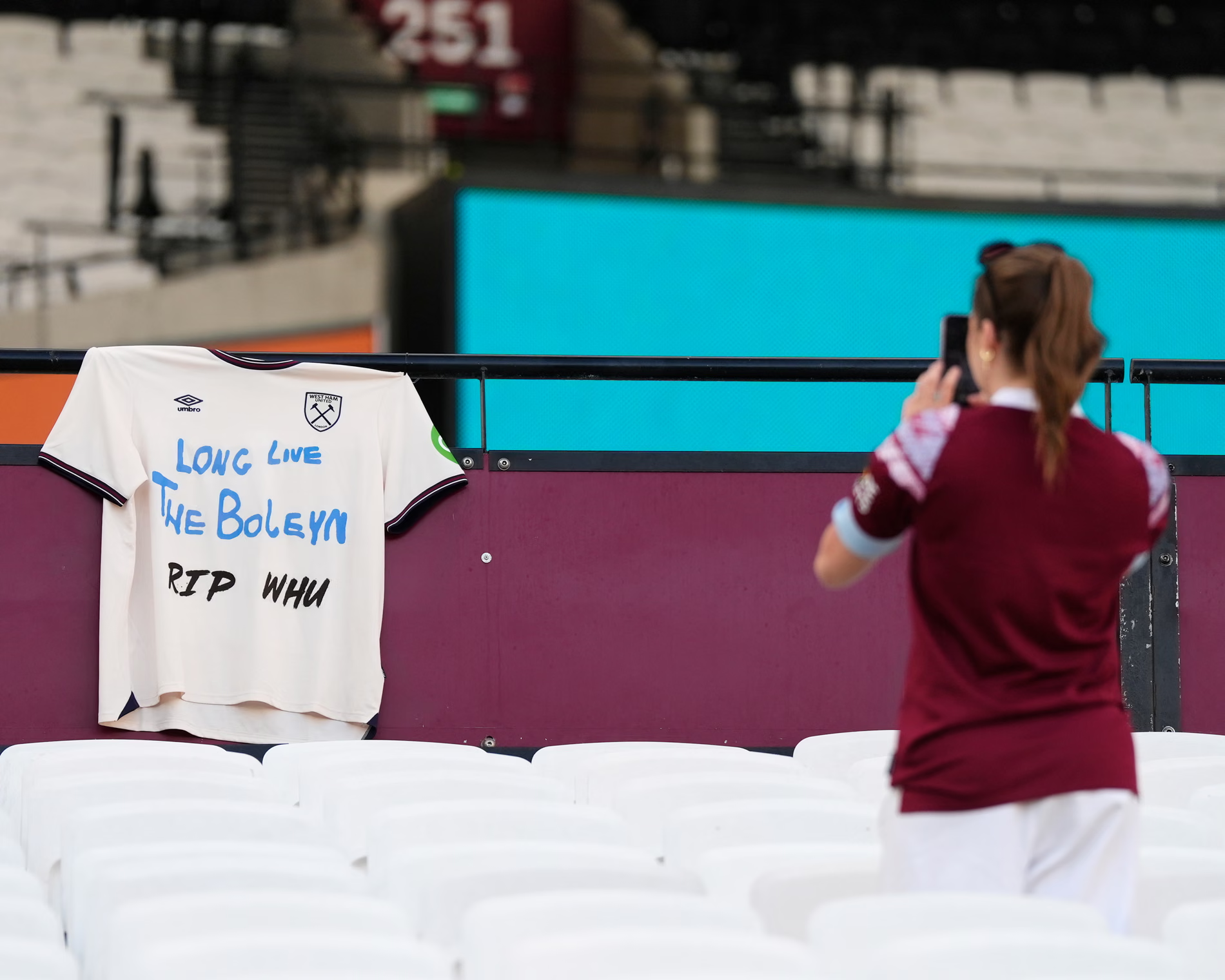
I remember the day they announced the move to Stratford. Standing on Boleyn Road, the street where I grew up, where my father took me to my first match in 1968, I felt something break inside me. The club’s promise was grand: “We will build a world class team for the world class stadium.”
After 40-odd years of standing on those terraces, singing those songs, and bleeding claret and blue, I knew it was a lie. Not because I’m psychic, but because I’d heard the board’s promises before. Every single one had crumbled like the old East Stand brickwork.
Now, in May 2026, West Ham United have been relegated from the Premier League with 39 points a total that would have kept them up in most seasons. The London Stadium, that soulless bowl in Stratford, will host Championship football next season. And I feel vindicated, though I take no pleasure in it.
This isn’t just another relegation story. This is a cautionary tale about what happens when a football club forgets its soul, when boardrooms chase Olympic stadiums instead of building proper teams, and when fans’ warnings go ignored for over a decade.
The Upton Park Years: What We Actually Lost in 2016
When people talk about the move from Upton Park to the London Stadium, they focus on atmosphere and tradition. That’s true, but it misses the deeper point. The Boleyn Ground wasn’t just a stadium it was woven into the fabric of East London.
I could walk to matches from my childhood home. My local pub was everyone’s pre-match spot. The chip shop on Green Street knew my order. That’s not nostalgia that’s community infrastructure that took 112 years to build.
The last match at Upton Park in May 2016 against Manchester United felt like a funeral. We won 3-2, Winston Reid scored the winner, and grown men wept. I was one of them. The club promised the move would take us to the next level. David Sullivan stood there saying we’d compete with the big boys, that the extra 26,000 seats would mean extra revenue for world-class signings.
Ten years later, we’re relegated. Those 26,000 extra seats? Half-empty most weeks, filled with tourists and day-trippers who don’t know the words to “Bubbles.” The world-class signings? A revolving door of expensive failures and panic buys.
Why I Walked Away: Recognizing the Pattern of Broken Promises
The 2016 promise wasn’t the first lie. That’s what people outside don’t understand. When David Sullivan and David Gold took over in 2010, they promised ambition. We’d challenge for Europe, they said. We’d build gradually and sustainably.
What actually happened? They sold our training ground to developers. They appointed manager after manager without any coherent plan. They chased marquee signings for shirt sales instead of building a proper squad.
I remember the 2015-16 season Slaven Bilic’s first year. We finished seventh, played brilliant football, and Dimitri Payet was magical. That summer, instead of building on that foundation, the board got distracted by the Olympic Stadium move. Payet wanted out within months. The writing was on the wall.
So when they made that “world-class team for a world-class stadium” promise, I’d already seen this film. My son, who was 19 at the time, asked if we’d still go to matches. I told him the truth: “Not until they prove they actually care about the football club instead of the property deal.”
Some called me disloyal. A fair-weather fan. But loyalty runs both ways. After 40 odd years of supporting the club through thick and thin and mostly thin I’d earned the right to expect honesty from the people running it.
The London Stadium Disaster: A Monument to Poor Planning
The London Stadium was never designed for football. It was built for athletics, for a two-week Olympic party in 2012. Converting it cost £323 million of public money, and the result is a stadium where fans sit miles from the pitch, where the atmosphere dies in the cavernous roof space, and where the club doesn’t even own the ground.
West Ham pay rent to the London Legacy Development Corporation. Think about that. A Premier League club , now a Championship club paying rent like a tenant. No control over non-matchday revenue. No ability to modify the stadium properly. And they sold our beloved Boleyn Ground for this.
I went to one match at the London Stadium in 2016, the home opener against Bournemouth. We lost 1-0, and the crowd was flat. Standing in the concourse at half-time, surrounded by concrete and corporate branding, I thought: “This isn’t West Ham anymore.”
The stadium holds 62,500. In the Championship, they’ll be lucky to fill 35,000 for most games. It’ll be a morgue. And the financial implications are terrifying, higher operating costs, rent payments, and massively reduced revenue. The very economics that were supposed to save us will now bury us.
The Sullivan Era: A Timeline of Decline
Let me walk you through what 16 years of David Sullivan’s ownership actually delivered:
2010-2011: Took over, promised stability. Relegated to the Championship immediately. Got lucky with a play-off final victory to bounce back.
2011-2015: Mid-table mediocrity. Sold our training ground in Chadwell Heath to developers. Appointed and sacked Sam Allardyce despite him achieving the stated objective of Premier League survival.
2015-2016: Appointed Bilic, had one good season. Immediately undermined it by obsessing over the stadium move instead of squad investment.
2016-2017: First season at London Stadium. Chaos. Fan protests. Slaven struggling with an unbalanced squad. Finished 11th after flirting with relegation.
2017-2021: Managerial merry-go-round. Bilic sacked, David Moyes in, Moyes out, Manuel Pellegrini in with big promises, Pellegrini sacked during a relegation fight, Moyes back in to save us. No coherent strategy, just panic and reaction.
2021-2024: Moyes stabilized us, got us into Europe twice. But instead of backing him properly, Sullivan undermined him publicly and refused to invest in the squad depth needed to compete on multiple fronts. Moyes left in 2024, exhausted.
2024-2026: Appointed Nuno EspÃrito Santo. Gave him a weak squad. Refused to invest properly in January 2025 or January 2026 when relegation loomed. Relegated with 39 points.
See the pattern? Short-term thinking, broken promises, managerial instability, and a fundamental unwillingness to invest in the football side while happily taking property profits.
The 39-Point Relegation: Why This Season Was Different
Normally, 39 points keeps you up. West Ham went down with that total because the Premier League’s competitive balance shifted dramatically in 2025-26. The gap between the top six and everyone else widened, but more importantly, the bottom 14 teams became incredibly tight.
On the final day, West Ham beat their opponents 3-0. Jarrod Bowen, the captain and one of the few players who actually cares, scored from a tight angle. Taty Castellanos finally converted after wasting chances all match. But it didn’t matter. Other results went against us.
The atmosphere inside the London Stadium that day told you everything. When Castellanos scored the opening goal, the cheer was immediately drowned out by chants against David Sullivan. “Sold our soul for this shithole,” sang the fans who’d stuck around the ones I’d left behind in 2016.
I watched on television from my living room in Loughton, I didn’t feel vindicated. I felt sad. This didn’t have to happen.
Nuno EspÃrito Santo’s programme notes that day were telling. He wrote about how West Ham’s fate wasn’t in their hands. True, but whose fault was that? A club with West Ham’s history and resources shouldn’t be fighting relegation with two games to go.
What Happens Next: The Championship Reality Check
Here’s what West Ham fans who’ve stuck around need to understand: the Championship is brutal. It’s not a one-season pit stop. Just ask Sunderland they spent six years down there. Sheffield Wednesday. Leeds United took 16 years to return (though they’ve had their own ups and downs since).
The 2011 relegation was different. We had a core of Premier League players, a manager in Sam Allardyce who knew the division, and momentum. We went up through the play-offs but it was far from guaranteed.
This time? Different universe. The squad is weaker. The wage bill is unsustainable for the Championship. Key players have relegation release clauses they’ll be gone by July. And most importantly, the club’s infrastructure is built for Premier League revenue that’s about to disappear.
West Ham will lose approximately £100 million in television revenue alone. The parachute payments help, but they’re not enough when you’re paying Premier League wages and rent on a 62,500-seat stadium that’ll be two-thirds empty.
Player sales are inevitable. Jarrod Bowen will go probably to a top-six club. Any decent prospect will be sold to balance the books. West Ham will rebuild with loan players, free transfers, and journeymen. That’s not a recipe for instant promotion.
The London Stadium will become what many of us predicted: a white elephant. A vast, soulless venue hosting second-tier football in front of sparse crowds. The atmosphere, already poor, will be funereal.
The Bigger Lessons: What West Ham’s Fall Teaches Modern Football
West Ham’s relegation is a case study in how not to run a football club. It exposes several fundamental problems in modern English football:
Property deals aren’t football strategy. The board saw the Olympic Stadium as a property opportunity, not a sporting one. They chased capacity and location instead of atmosphere and community.
Broken promises destroy trust. You can only lie to your supporters so many times before they stop believing. I walked away in 2016. Thousands more followed over the next decade. The empty seats at the London Stadium aren’t just about atmosphere they represent broken relationships.
Short-term thinking kills clubs. Every decision Sullivan’s regime made was about the next quarter, the next property deal, the next headline signing. Never about building a sustainable football club with a coherent identity.
Fans know their clubs better than investors. West Ham supporters warned about every single problem that led to relegation. The stadium would be soulless. The team needed proper investment. The managerial instability was destructive. We were ignored.
History and tradition matter. Football clubs aren’t normal businesses. They’re community institutions with 100+ years of history. You can’t just relocate them like a retail chain and expect the magic to transfer.
I spent 47 years at West Ham. I know this club inside and out. I knew the stadium move was wrong. I knew the promises were hollow. And I knew that eventually, the chickens would come home to roost.
They just did. Relegated. Championship football. And a long, uncertain road back.
Conclusion: A Club at a Crossroads
West Ham’s relegation in 2026 wasn’t bad luck. It wasn’t the referee’s fault, or one manager’s failure, or a few poor results. It was the inevitable conclusion of ten years of terrible decisions, broken promises, and fundamental mismanagement.
I grew up on Boleyn Road. West Ham was my life for four decades. Walking away in 2016 was one of the hardest things I’ve ever done, but it was the right decision. I refused to validate a business model built on lies and property speculation.
Now the club I love is in the Championship, playing in a stadium that will never be home, run by owners who have comprehensively failed in their duty to supporters.
Will I go back? Maybe. If Sullivan sells. If the new owners show they understand what West Ham United actually is an East London institution, not a property portfolio. If they commit to building a proper football club instead of chasing quick profits.
Until then, I’ll watch from a distance. I’ll hope for better. And I’ll remember the Boleyn Ground, where football clubs still had souls.
If you’re a West Ham fan struggling with what comes next, know this: your anger is valid. Your sadness is real. And your club deserves better than what it got.
What’s your West Ham story? Did you make the move to Stratford, or did you walk away like me? Share your experiences in the comments below. And if you know someone who needs to read this, send it to them. We’re all Hammers, whether we go to the games or not.
Frequently Asked Questions About West Ham’s Relegation
When was West Ham last relegated before 2026?
West Ham were previously relegated in 2011, also under David Sullivan and David Gold’s ownership. They bounced back after one season through the Championship play-offs, defeating Blackpool 2-1 in the final at Wembley. However, the circumstances in 2026 are significantly different, with a weaker squad and unsustainable financial structure making immediate promotion far from guaranteed.
How many points did West Ham get relegated with?
West Ham were relegated with 39 points, the highest relegation total in the Premier League since Birmingham City went down with 39 points in 2011. This historically unusual situation occurred because the competitive balance in the 2025-26 season was exceptionally tight in the bottom half of the table, meaning the usual “safe” points threshold proved insufficient.
What will happen to the London Stadium if West Ham are in the Championship?
The London Stadium will face significant challenges hosting Championship football. With a 62,500 capacity, the venue will likely be less than 60% full for most matches, creating a poor atmosphere and reducing matchday revenue. West Ham still pay rent to the London Legacy Development Corporation regardless of which division they’re in, creating serious financial pressure. The stadium could become what critics call a “white elephant” a massively oversized venue unsuitable for second-tier football.
Why did fans protest against David Sullivan during the relegation match?
Fans protested against David Sullivan during West Ham’s final match because they hold him primarily responsible for the club’s decline. His ownership has been characterized by broken promises (particularly the “world-class team for a world-class stadium” pledge), poor transfer strategy, managerial instability, and the controversial move from Upton Park to the London Stadium. The protests, including chants that occurred even as West Ham were scoring goals, reflected a decade of accumulated frustration.
Can West Ham get promoted back to the Premier League immediately?
While possible, immediate promotion is far from guaranteed. West Ham face several obstacles: unsustainable Premier League wages in a Championship budget, likely player sales due to relegation clauses, loss of approximately £100 million in TV revenue, and the challenge of filling a 62,500-seat stadium for second-tier football. The Championship is notoriously difficult, with clubs like Sunderland spending six years in the division and Leeds taking 16 years to return to the top flight. West Ham’s 2011 bounce-back occurred in very different circumstances with a stronger squad foundation.
- West Ham Relegation 2026: How Broken Promises and Bad Decisions Destroyed an East London Institution
- England’s 2026 World Cup in context
- When a £200m Game Meets a Spygate Scandal: Hull City, Southampton and the Play‑Off Fallout
- William Hill Glitch: “I Thought They Tell Us Machines Are Random” – What Players Need to Know
- How Does 360WIN Work? An Honest Guide From a Betting Affiliate